DM Vans.
Full-funnel UX,
from ad to inquiry.
Transforming a fragmented experience into a guided, high-converting journey that drove higher intent, lower CPL, and 2× more booked consultations.
Strong demand, weak conversion.
DM Vans builds custom camper vans and sells direct-to-consumer in a high-consideration market. Paid media was driving traffic; the funnel underneath wasn't built to turn a curious clicker into a booked consultation.
I led the end-to-end redesign — auditing the experience, restructuring the funnel, and building a conversion system that paired tightly with the paid-media strategy.
The problem.
The homepage was the problem. Qualified buyers landed, scrolled, and left — the page looked the part, but wasn't doing the work. A quick UX audit pointed at the leaks immediately, and a few targeted fixes were enough to move the conversion rate fast.
- 01 One CTA, no map"Schedule a guided call" was the only door — buried below the fold and a leap too soon for most visitors.
- 02 Inventory experience was disorientingCategorical filters, no recommendation engine, no clear visual map.
- 03 One generic flow for every intentEducate, browse, and decide all routed through the same form — no path for the buyer who wasn't ready yet.
- A Reduce friction in the buying experienceGet high-intent visitors to the next step without forcing them to read everything first.
- B Increase qualified booked consultationsBetter-matched leads, fewer wasted sales-call hours.
- C Create a new flow to qualify leadsAn interactive entry point that did the qualifying work the form couldn't.
 Hover to scroll ↓
UX strategy & CRO roadmap.
A three-tier roadmap: ship quick wins immediately, scope structural changes in parallel, build the infrastructure that compounds over time.
Quick wins.
Highest-leverage edits to the existing pages — minimal engineering lift, maximum learnings.
- New hero CTA built around intent
- Sticky CTA in the header
- FAQ added above the form
- Re-ordered homepage content for ranking on intent
- CTA added to inventory item pages
- Filtering simplified on inventory
Intermediate improvements.
Structural changes to the most-trafficked surfaces — homepage, inventory, and individual van pages.
- Redesigned navigation with positioned CTAs
- New homepage layout focused on macro listings
- Individual Van pages restructured for clarity
- Form moved below the fold with intent-qualifying questions
Long-term improvements.
The infrastructure pieces that took longer to build but unlocked the biggest compounding lift.
- The Van Quiz — a guided recommendation engine
- Mobile navigation redesign
- Calendly-based booking system integration
- Mobile UX testing structure
The new conversion funnel.
High drop-off
Problems: No personalization. No guidance. No qualification. Every visitor — researcher, browser, or ready buyer — was forced through the same long path, leading to high drop-off and low-quality leads.
Qualified lead
Impact: The homepage now welcomes two intents at once. High-consideration buyers get a guided quiz; ready-to-browse buyers go straight to inventory. Both converge on a qualified consultation booking instead of a dead-end contact form.
Four structural moves.
The most important changes were structural — what users were asked to do, in what order, with what context.
 Hover to scroll ↓
Two paths from the first scroll — "Find your van" for browsers, "Book a consultation" for ready buyers. Each visitor type got the right door.
- Above the fold
- Intent-matched
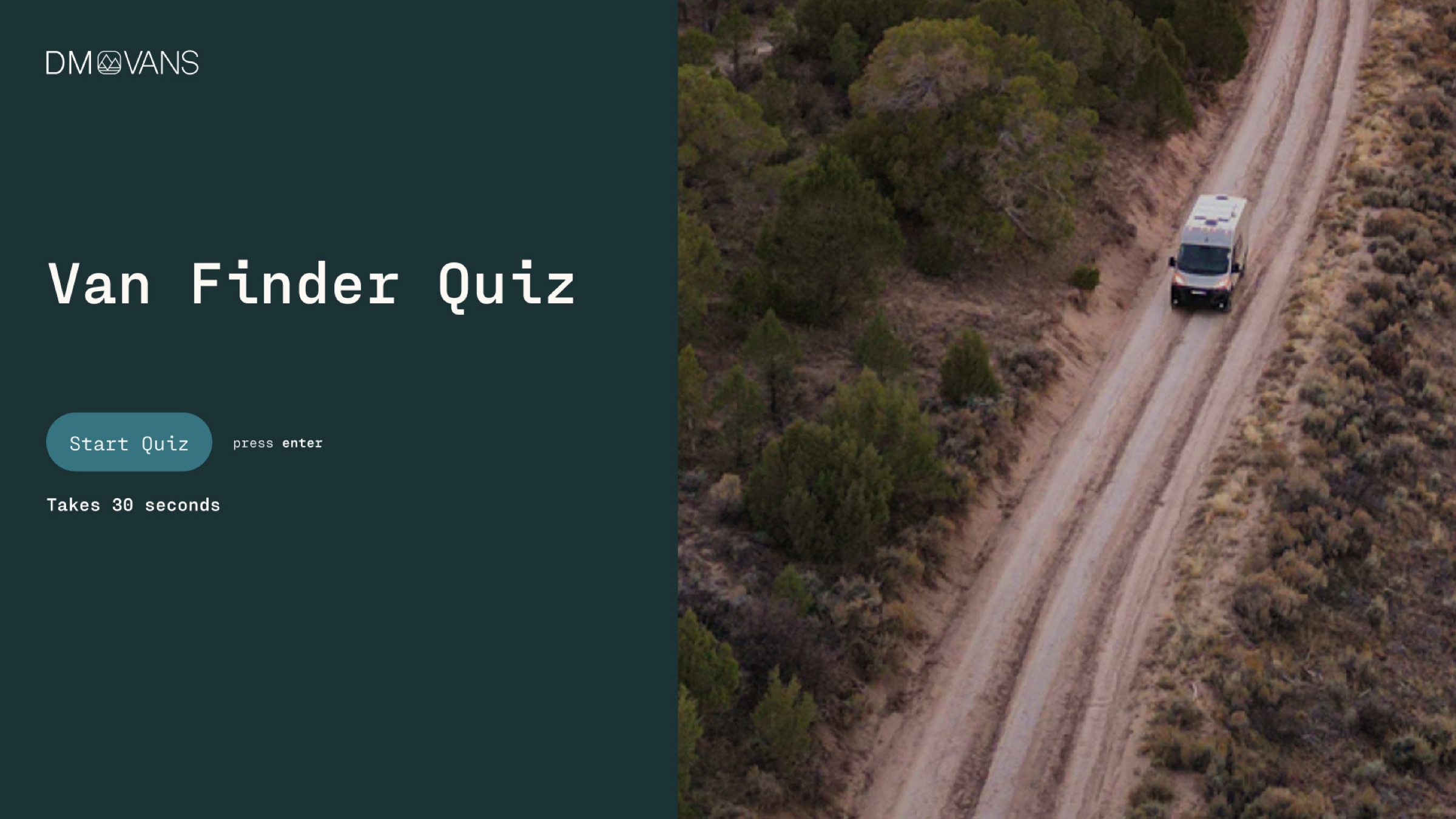
Five short questions across vehicle, lifestyle, budget, and timing — returns matched vans and captures email for follow-up. Single biggest lever in the redesign.
- 5 questions
- 30 seconds
- Email capture
Grouped by model type. Fewer clicks to a listing. Comparison tool added so visitors could recall what they'd seen — fewer false starts across the session.
- Model-type groups
- Compare tool
A consulting-style layout: clear feature breakdowns, spec sheets, CTA up-page. Time on page lifted materially.
- Spec sheets
- CTA up-page
Business impact & measured outcomes.
Before the long-term features even shipped, the early fixes and mid-level updates compounded into stronger results across every paid channel.
Lead conversion rate
Google Ads, after early UX clarity and funnel adjustments.
CTR improvement
Search campaigns with aligned messaging and new paths.
Branded leads
Higher intent → stronger lead quality.
Calendly calls
From 28 → 50 calls MoM after UX improvements.
CPL reduction
Search campaigns — better CTA clarity, cheaper conversions.
Cost per schedule
Meta retargeting after aligning with the new UX flow.
PMAX emerged as the top call driver once UX improved. Traffic converted significantly better.
More users marked "Looking to buy in 1–3 months" and "Immediately," leading to more opportunities in HubSpot.
What I'd carry forward.
The scattered, ecommerce-style experience was redesigned into a clear, step-by-step funnel that guided users through their decisions. For a high-consideration buy, browsing is a delay — the quiz wasn't a UI trick, it was a permission slip to skip the parts of the funnel that didn't help. Built on strong UX principles and CRO best practices, with quick wins compounding into long-term growth.
Worked closely with.
to align landing experience with new ad creative
on the modular component build and quiz logic
on data-informed tracking and validation